Central Hospital Stories
- 4.5
- Rating
- 50.00M
- Installs
- Free
- Price
 Analysis by App-foxy
Central Hospital Stories is the kind of educational game I would hand to a child who enjoys pretend play more than traditional lessons. I spent time moving through its hospital setting, trying different roles and building small stories around the patients, staff, rooms, and objects available to me. My main impression is that it succeeds because it does not turn learning into a quiz. Instead, it gives children a safe-looking place to explore care, routines, and cooperation through play.
That strength also defines its limits. This is not a medical simulator, a structured science course, or a game built around difficult goals. It is a gentle role-playing experience from SUBARA, aimed at children who like inventing situations and repeating familiar actions. If you expect detailed hospital procedures or a clear progression system, you may find it too open-ended. If you want a calm activity that encourages storytelling and observation, it has much more to offer.
How the hospital world works in everyday play
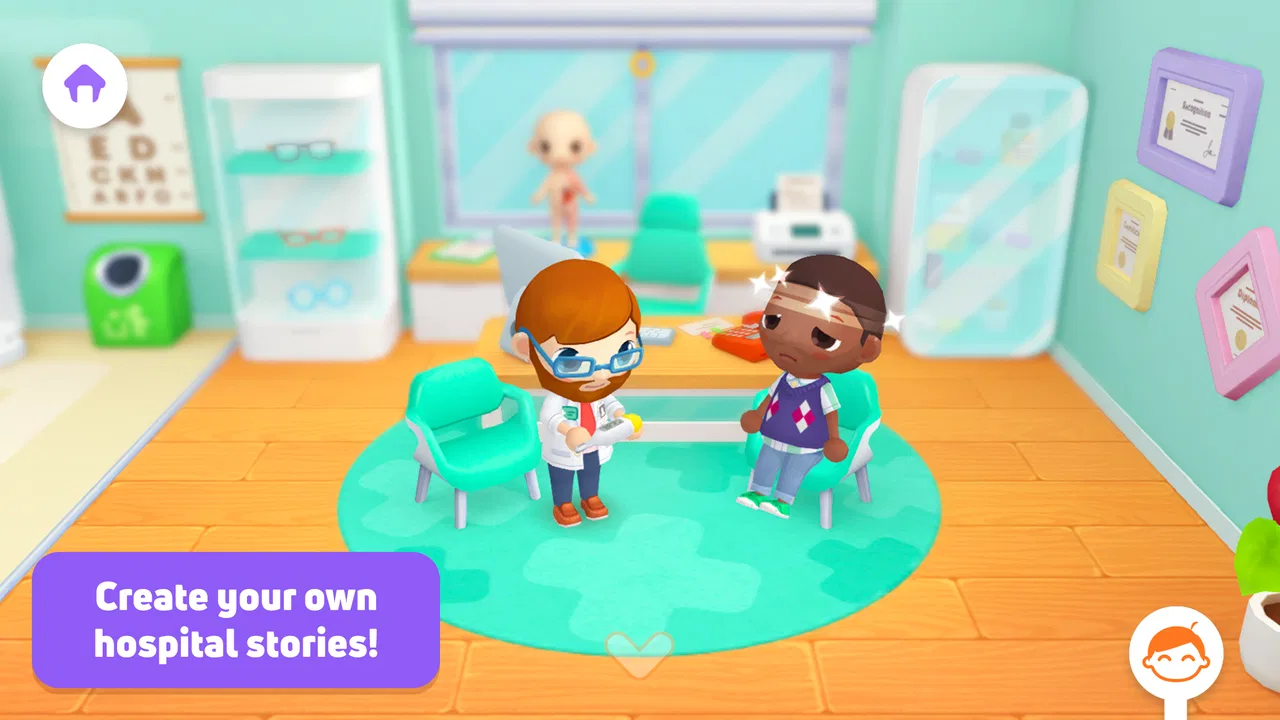
The central idea is simple: I take on the role of a doctor and explore a hospital while creating my own little adventures. The game’s appeal comes from deciding what is happening rather than following a rigid mission. One session can become a checkup, another can focus on helping a patient, and another may simply involve visiting different parts of the hospital and seeing what can be interacted with.
You May Also Like

 Blood Strike: 2.5 Anniversary
Blood Strike’s Loadouts Turn Every Drop Into a Tactical Gamble
A close look at Blood Strike’s custom loadouts: how fast access to signature weapons reshapes its battle royale rhythm, rewards preparation, and narrows the gap between fights.

 Pandora - Music & Podcasts
Pandora’s Music Is Easy to Start, but Harder to Recover
Pandora’s strength is its low-effort path from a seed to a station. Its weak spot is how much confidence it asks you to place in connection, setup, and quiet recovery.

 8 Ball Pool
 Is Built on Rivalries, Rematches, and Routine
A close look at the rivalries, rematches, shared routines, and unanswered safety questions that turn a quick pool match into a persistent mobile community.

 Samsung Music
’s Quiet Strength Is Playing What You Already Own
Its reach comes less from spectacle than from dependable access to a personal library. That simplicity is both the app’s strongest retention engine and its ceiling.

 AccuWeather: Weather Radar
AccuWeather Review: A Quick, Clear Forecast for Everyday Decisions
For everyday plans, the best forecast is the one you can understand quickly. AccuWeather makes rain timing, radar, and local conditions easy to act on, with a few trade-offs.

 Hill Climb Racing
Why Hill Climb Racing Still Turns Crashes Into One More Run
A tiny car, a bumpy hill and one more upgrade: Hill Climb Racing keeps resurfacing because its simple chaos makes every near-miss feel personal.
More From Our News Desk



That freedom makes the experience feel closer to a digital dollhouse than to a conventional game. Children can move between activities at their own pace, pause when their attention shifts, and return to a familiar setting without having to remember complicated rules. I found that especially useful for younger players who enjoy repeating a scenario until they feel they have mastered the story, even when the game itself does not describe that repetition as progress.
The educational value is indirect but real. The hospital setting introduces ideas about care, communication, responsibility, and the different people who help a medical environment function. It does not teach these topics through long explanations. Instead, it lets the player act them out. That distinction matters: the child is practicing imaginative organization and social understanding, not memorizing medical facts.
For a parent, the best way to view it is as guided pretend play. Asking a child what happened to a patient, why a doctor might need to examine someone, or what should happen next can turn a short play session into a useful conversation. Without that interaction, the game remains entertaining, but much of its learning potential stays inside the child’s own imagination.
Why the open-ended design is its strongest feature
I usually become cautious when a game for children claims to be educational, because many of them replace play with repetitive taps and obvious rewards. Central Hospital Stories takes a different route. Its hospital gives children a theme and a collection of situations, then leaves room for them to decide how those situations connect.
That design is particularly effective for siblings or a child playing beside a parent. One person can invent the patient’s problem while another takes the doctor’s role. Even when only one child is holding the device, the game creates natural prompts for conversation. The player can explain what they are doing, name the people involved, and build a sequence of events that feels personal rather than prewritten.
A useful tip is to begin with a small story instead of trying to explore everything immediately. I get more from the game when I choose one simple scenario, such as welcoming a patient, checking a room, and deciding what should happen afterward. This keeps the play focused and makes it easier for a child to describe the sequence. Later, the same setting can support more complicated stories without introducing extra rules.
Another worthwhile approach is to let the child lead while the adult asks questions only when the story stalls. Constantly correcting the player defeats the purpose of the open design. The game works best when the child is allowed to make harmless choices, change direction, and discover relationships between rooms and characters independently.
What makes it different from ordinary learning apps
Compared with a spelling, counting, or science app, this game offers less measurable instruction. There are no lessons for me to complete in a conventional sense, and the experience does not depend on getting answers right. That can be a disadvantage if you are looking for a tool that supports a particular school subject.
Compared with a traditional hospital-themed game, however, it feels less stressful and more accessible. There is no need to react quickly or understand a complicated interface before the play becomes enjoyable. The child can focus on role-playing rather than winning. For children who become frustrated by timers, failure screens, or competitive scoring, that difference is important.
It also compares favorably with passive video entertainment. A video supplies a finished story, while this game asks the child to create one. The result is not automatically better for every child—some children simply prefer watching—but it gives an imaginative player more control and more reason to speak aloud about what is happening.
The trade-off is that the game may feel quiet or directionless to anyone who needs constant objectives. I noticed that its value depends heavily on the player’s willingness to invent. A child who wants explicit instructions may wander briefly and then lose interest. In that situation, an educational app with short challenges and visible goals would probably be a better choice.
Where the experience can become repetitive
The same freedom that makes the game approachable can also reduce its sense of momentum. Once a child has explored the hospital and repeated favorite scenarios, there may be less motivation to continue unless they enjoy creating new stories. I would not choose it for a child who measures fun mainly through unlocking stages, collecting rewards, or beating personal scores.
This is also not the right game for teaching real medical decision-making. A child may learn that hospitals involve helping, examining, and caring for people, but the experience should not be treated as a source of medical guidance. Its hospital is a setting for imaginative play, not a substitute for a lesson from a qualified adult or a reliable health resource.
Parents should also be prepared for the possibility that a child will interpret the setting in a very personal way. One player may focus on kindness and teamwork, while another may turn every visit into a dramatic emergency. That flexibility is part of the appeal, but it means the tone is not fully controlled by the game. If a child is anxious about hospitals, I would watch the first session and see whether the theme feels comforting, neutral, or unsettling.
The in-app purchase model is another practical consideration. The game is free to start, while individual purchases range from $3.49 to $4.49. I would check the device’s purchase controls before giving a child unsupervised access. Even when the core experience is enjoyable without spending, children may not understand that a tap can lead to a real charge.
Who will get the most from it
Central Hospital Stories is best suited to children who enjoy pretend professions, caring for characters, and making up dialogue. It is a particularly good fit for a child who already turns household objects into medical equipment or asks to play doctor. The hospital theme gives that interest a structured setting without forcing the child into a single correct storyline.
It can also work well during a short quiet period at home. For example, I can imagine a child playing after school while a parent prepares dinner, then explaining a newly invented hospital adventure afterward. The activity is easy to enter and does not require the family to learn a rulebook first. A parent can extend the session by asking the child to describe the patient’s journey from arrival to care.
Preschool and early elementary players are likely to understand its role-playing appeal most quickly, although the exact fit depends on the child’s reading ability, patience, and comfort with open-ended play. The content rating is Everyone, which makes it broadly approachable for families, but that does not mean every child will respond to the hospital theme in the same way.
I would skip it for a child who needs strong educational structure. If your goal is practicing arithmetic, learning vocabulary, or reviewing anatomy, a focused learning app will provide clearer results. I would also look elsewhere for a child who wants a fast-paced challenge, competitive play, or a deep simulation with realistic consequences.
The game is available as a free title, which makes it easy to try before deciding whether the style suits your family. Its average rating is 4.5 from around 151 thousand ratings, and it has passed 50 million installs, so it is clearly familiar to a large audience. Those figures do not replace personal testing, but they do suggest that its gentle hospital role-play has broad appeal.
Practical details that matter before installing
Central Hospital Stories was released on April 13, 2019, and the current version is 1.8.9. It requires Android 7.0 or later. I would check the operating system first, especially on an older family tablet, because a child-friendly game is not useful if the device cannot install or run it properly.
The free entry point is helpful for testing the tone and interaction style. I recommend spending a few minutes watching how the child plays before considering any optional purchase. If the child immediately invents stories and returns to the hospital willingly, the extra content may feel worthwhile. If the child needs repeated prompting to interact, paying for more of the same style is unlikely to solve the underlying mismatch.
One of the most useful ways to assess it is to observe what the child does after the first exploration. Does the player start assigning roles, explaining events, and creating a sequence? Or do they tap around briefly and wait for the game to tell them what to do? The first response indicates a strong match; the second suggests that a more guided alternative would be more satisfying.
I also recommend treating the game as a conversation starter rather than a digital babysitter. A few minutes of adult participation can reveal whether the child understands the difference between pretend medical care and real care. It can also turn a repetitive play loop into a richer story about empathy, patience, and helping someone who feels unwell.
My final recommendation
After spending time with it, I see Central Hospital Stories as a successful educational role-playing game with a deliberately soft approach. Its strongest achievement is giving children a hospital environment without demanding speed, competition, or correct answers. The player’s imagination supplies the structure, and that makes the experience more personal than a standard lesson.
Its weakness is equally clear: children who need goals, progression, or substantial factual teaching may run out of reasons to play. The open-ended format can feel wonderfully liberating to one child and frustratingly vague to another. Optional purchases also deserve adult attention, particularly on a shared device.
My recommendation is straightforward. Choose it if your child likes pretend play, enjoys caring for characters, and benefits from calm activities that encourage conversation. Try something more structured if the priority is measurable academic practice or challenging gameplay. For the right player, it is a friendly digital hospital where stories can grow naturally; for the wrong player, it is simply a collection of scenes waiting for imagination that may never arrive.
In my view, that makes it worth trying precisely because the starting cost is free. Give the child a short, supervised session, ask them to invent one complete hospital story, and see whether they take ownership of the world. If they do, SUBARA’s game can become a surprisingly useful space for creative play. Its real strength is not teaching medicine; it is teaching children to build, explain, and care through play.
FAQs for Central Hospital Stories
01What is Central Hospital Stories about?
Central Hospital Stories is an interactive simulation game where players manage a hospital. You can take on roles such as doctors, nurses, and patients, exploring a vibrant and engaging medical environment. The game encourages creativity and storytelling, ideal for kids and families looking to create their unique hospital stories.
02Is Central Hospital Stories suitable for children?
Yes, Central Hospital Stories is designed with children in mind. It features a family-friendly environment with easy-to-use controls and engaging scenarios. The game promotes creativity and imagination, making it an excellent tool for educational play. Parents can rest assured knowing the content is appropriate for young audiences.
03Do I need an internet connection to play Central Hospital Stories?
No, an internet connection is not required to play Central Hospital Stories. The game is fully functional offline, allowing players to enjoy the interactive experience anywhere, anytime. This feature makes it convenient for on-the-go play, whether you're traveling or simply without internet access.
04Are there in-app purchases in Central Hospital Stories?
Yes, Central Hospital Stories offers in-app purchases. These can enhance the gameplay experience by providing additional features, characters, or items. While the basic game is enjoyable on its own, these purchases offer more customization and variety. Parents should monitor purchases if children are playing the game.
05What platforms is Central Hospital Stories available on?
Central Hospital Stories is available on both Android and iOS platforms. It can be downloaded from the Google Play Store and the Apple App Store, ensuring compatibility with a wide range of devices. Make sure your device meets the minimum requirements for a smooth gaming experience.
Pros
- Engaging and interactive storyline.
- Wide variety of medical scenarios.
- User-friendly interface for all ages.
- Educational value for young players.
- Colorful and appealing graphics.
Cons
- Limited free content available.
- In-app purchases can be pricey.
- Some scenarios feel repetitive.
- Requires constant internet connection.
- Occasional minor bugs and glitches.

Central Hospital Stories
Gallery